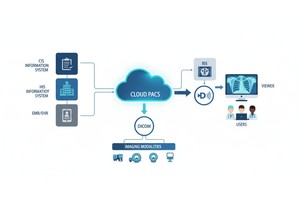
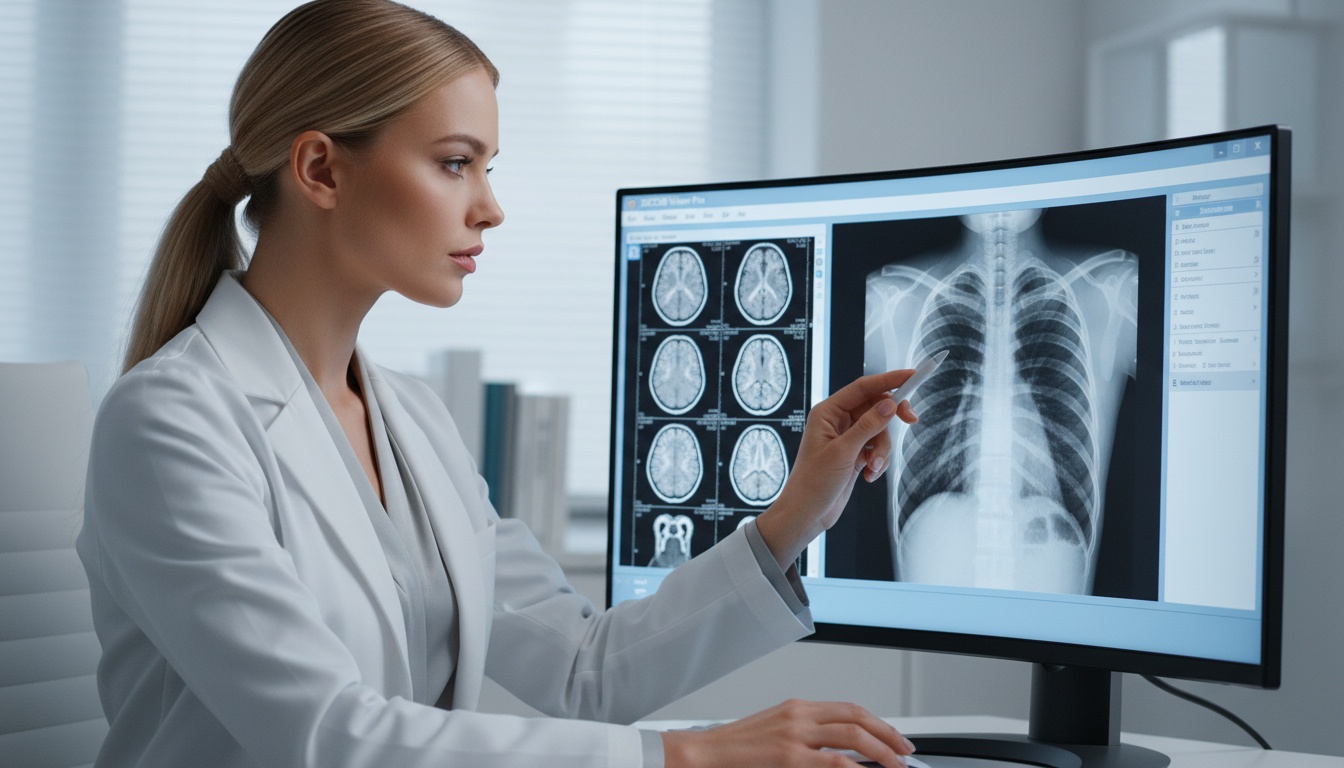
The contemporary healthcare systems do not remain isolated anymore. Hospitals, imaging centers, and multi-specialty clinics function in digital ecosystems that are tightly interwoven where clinical data, imaging studies, and patient records should move freely across departments and platforms. The key focus of this change is the incorporation of three systems that are considered important: Picture Archiving and Communication Systems (PACS), Radiology Information Systems (RIS), and Electronic Health Records (EHR).
When these systems do not work across the silos, inefficiencies arise- data entry, delay in diagnoses, fragmented workflow, and excessive administrative work. Nevertheless, when properly combined, PACS, RIS, and EHR systems create a single infrastructure improving clinical performance and patient outcomes and providing upscale healthcare delivery.
PACS integrates with RIS and EHR systems: how?
By applying the common protocols of DICOM, HL7 and FHIR, PACS connects with RIS and EHR systems to facilitate seamless data exchange among imaging systems, radiology processes and patient health records.
This integration allows:
- EHR orders to be imaged in RIS.
- Imaging data to be stored and retrieved via cloud-based PACS.
- Radiology reports are automatically transferred out to the EHR.
The outcome is a complete linked imaging workflow which minimises manual operations, shortens diagnosis time and enhances a better coordination of care.
• Integration Of Pacs, Ris And Ehr Provides A Single Imaging Workflow In Healthcare Systems.
• Standards Such As Dicom, Hl7, And Fhir Allow Platforms To Interoperate With One Another.
• Electronic Systems Eliminate Manual Procedures, Enhance The Speed Of Diagnosis, And Increase The Accuracy Of Data.
• The Cloud-based Pacs Is Highly Integrated Where Its Legacy Infrastructure Counterpart Is Very Hard To Integrate.
• Those Healthcare Organizations That Implement Integrated Imaging Systems Are In A Better Situation To Scale And Innovate In The Future.
It is necessary to comprehend the role of each system in the healthcare infrastructure before proceeding on the issue of integration.
So, let’s understand what PACS is and how it works. The task of PACS is to store medical images like CT scans, MRIs, X-rays, and ultrasounds and retrieve them and distribute them. Modern cloud PACS solutions, especially cloud-based systems, provide a secure access to imaging data between devices and locations.
RIS takes care of the operational sphere of the radiology departments. It handles:
• Patient Scheduling
• Imaging Orders
• Workflow Tracking
• Report Generation
RIS serves as the radiology workflow.
The EHR systems are the hub of patient health data, including:
• Medical History
• Lab Results
• Physician Notes
• Imaging Reports
Clinicians in different departments operate mostly through EHR.
Despite close relations between PACS, RIS, and EHR systems, their roles in the healthcare system are different. Such differences are useful to gain an insight as to why integration is vital.
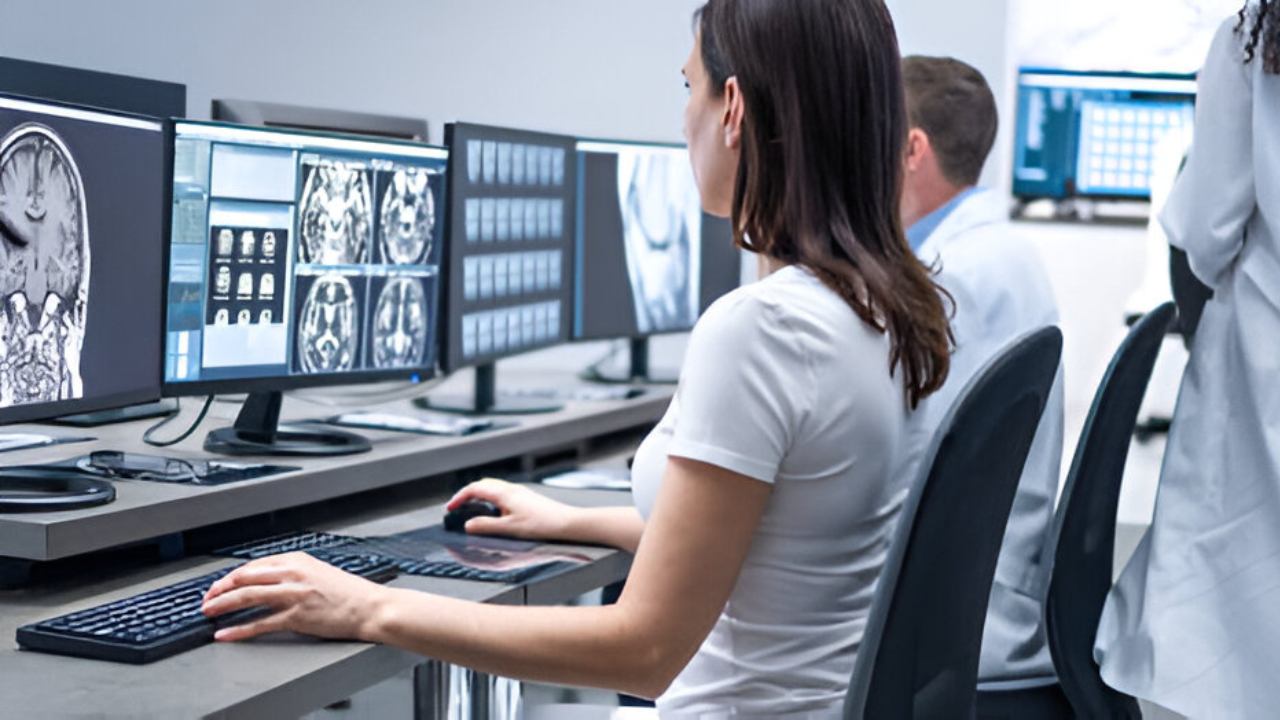
| System | Core Role in Healthcare | Data Type | Typical Users |
| PACS | Imaging storage and access system | Diagnostic images (DICOM format) | Radiologists, physicians |
| RIS | Radiology workflow and management system | Orders, scheduling, and reporting data | Radiology departments |
| EHR | Centralized patient record system | Clinical records, lab results, imaging reports | Clinicians, specialists |
PACS is concerned with imaging information, RIS is based on the management of radiology processes, and EHR presents the entire picture of the medical history of the patient. An integrated RIS/PACS system ensures that these systems serve as a coordinated system, as opposed to stand-alone utilities.
The healthcare delivery has been on a transformation path to a model based on speed, teamwork, and accessibility of information. Lack of integration means that every system is independent of each other and introduces the inconveniences of inefficiencies that directly affect patient care.
Under non-integrated environment:
• Orders Related To Radiology Have To Be Keyed In Using Several Systems.
• Results Of Imaging Are Deferential Or Unavailable.
• Clinicians Do Not Have An Overall View Of The Patients.
• There Is Increase In The Administrative Overhead.
Integration helps to get rid of these barriers and produce an organized ecosystem where data is automatically transferred between systems.
This is especially crucial in big hospital systems, telemedicine settings, and healthcare organizations with more than one location that require coordination.
A fully integrated PACS with HIS imaging workflow are based on systematic data sharing through systems.
 - Presented by PostDICOM.jpg)
• An Order Of Imaging Is Created In The Ehr System By A Physician.
• Hl7 Messaging Is Used To Send The Order To Ris.
• Ris Generates And Arranges The Imaging Process.
• Imaging Devices Take The Scans And Transmit Them To The Pacs In Dicom.
• Radiologists Retrieve Pacs Images And Write Reports.
• The Report Is Rerouted To The Ehr To Be Reviewed By The Clinicians.
This is a closed workflow through which imaging data is available throughout care delivery.
Workflows describe the movement of data, whereas the underlying architecture describes the efficiency and reliability of systems communication.
Integration, in the contemporary healthcare setting, is usually achieved in a middle layer that links PACS, RIS, and EHR systems.
Standard Integration Architecture.
 - Presented by PostDICOM.jpg)
This structure isolates clinical systems as well as imaging infrastructure so that every element is independent of each other without hindering communication.
Structured messaging like the orders and results are processed by the HL7 interface engine and the FHIR API layer allows real-time, flexible data exchange between apps of the modern era.
This architecture is made easier by cloud-based PACS solutions which bring storage services, access and integration features into a single environment and minimize reliance on intricate on-premise deployments.
Standards of communication are used to make healthcare interoperable. These standards are important to understand the way in which integration works.
The standard of the process of medical images handling, storage, and transmission is named DICOM. It provides compatibility of imaging devices and PACS systems to communicate effectively across the board.
HL7 is applied in the exchange of clinical as well as administrative data between systems. It supports:
• Patient Information
• Orders And Results
• Scheduling Data
HL7 has proven to be highly important in linking RIS and EHR systems.
FHIR is a new API-oriented standard, which is more flexible and fast in sharing data. It enables:
• Real-time Data Access
• Mobile And Internet Based Integrations.
• Interoperability Across Platforms Which Is Scalable.
HL7 has been very significant in the connection of RIS and EHR systems.
The transition of on-premise systems to cloud-based systems is also one of the most significant changes in medical imaging infrastructure.
• Needs The Use Of Local Servers And Hardware
• Complex Interface Engines
• High Maintenance Costs
• Limited Scalability
• Difficult Remote Access
• Centralized Cloud Infrastructure
• Integration (enabled By Api)
• Scalable And Flexible Architecture
• Location Access In Real Time
• Lower It Overhead
Cloud-native PACS systems make integration easier through making these systems less dependent on older systems and permitting uninterrupted connections with RIS and EHR environments.
Consider a multi-specialty hospital managing a high volume of imaging studies daily. The first step is setting up a medical device to cloud PACS routing.
Using the EHR, a physician orders a CT scan. The request is automatically sent to RIS where the patient is booked automatically. After the scan procedure is completed, the images are immediately stored in PACS and availed to radiologists.
The radiologist is remotely on the web-based DICOM viewer and issues a diagnostic report. This report will automatically be retransmitted to the EHR and the physician will access the report immediately and make treatment decisions.
Such a workflow will be integrated to remove delays, minimize errors, and improve interdepartmental performance.
Integration also lowers the impact of manual data entry and streamlines processes so that the healthcare staff are able to concentrate on the patient care instead of on the administration.
Imaging data can be accessed in real-time leading to faster interpretation and decision-making, which is vital in emergency and time-sensitive situations.
Automated exchange of data reduces the chances of errors that are related with manual data entry.
Imaging and reports are available to clinicians in all departments which enhances care coordination.
Lessening unnecessary processes and information technology infrastructure means lower costs of operation in the long run.
Older systems tend to have a problem in communicating with newer systems.
Solution: Cloud PACS for multimodal imaging uses standardized APIs and modern protocols such as FHIR to achieve compatibility.
Lack of integration leads to disunity of patient data.
Solution: Integrated architecture makes sure that there is a common access to the data.
On-premise systems must be constantly maintained and updated.
Solution: Cloud systems can help to decrease infrastructure load and also provide automatic upgrades.
Conventional systems do not allow access to certain places.
Solution: A web-based PACS server enables remote diagnostics and telemedicine, which are supported by a secure system anywhere.
Large hospitals are not the only ones that can be integrated. It is essential for:
• Physicians In Multiple Locations.
• Diagnostic Imaging Centers
• Telemedicine Platforms
• Specialized Clinics (cardiology, Oncology, Orthopedics)
• The Networks Of Healthcare Spread Throughout Regions
Integrated imaging systems can be of benefit to any organization in its bid to enhance efficiency, scalability, and care to patients.
All healthcare organizations do not begin with fully integrated systems, though there are indicators that integration is required.
Healthcare delivery providers should think of investing in integrated imaging infrastructure:
• The Volume Of Imaging Is Getting Bigger And The Workflow Is Becoming Unmanageable.
• There Are Several Systems That Involve Duplication Of Data.
• Late Access To Imaging Outcomes Influences Clinical Decision-making.
• Growth In Various Locations Leads To Coordination.
• Remote Diagnostics Or Telemedicine Acquires A New Status.
Integration may represent a strategic investment instead of a technical upgrade in North American healthcare systems, in which efficiency, compliance, and scalability are essential.
Organizations that adopt cloud-based PACS solutions are able to make this change faster since the latest platforms are architected to provide built-in EHR interoperability and API-based integration functions.
The future of healthcare cloud for medical imaging integration is being shaped by several emerging trends.
Artificial intelligence is also becoming part of PACS to support image analysis, anomaly identification, and prioritization of workflow.
APIs based on FHIR are allowing more rapid and more adaptable system and application integrations.
The trend toward healthcare organizations converging data platforms, which bring together imaging, clinical, and operational data into a single ecosystem is on the rise.
With the large-scale expansion of telehealth, cloud-based imaging infrastructure that is integrated will become an essential factor in facilitating remote diagnostics and international cooperation.
PACS is brought together with other systems such as RIS and EHR through standard such as DICOM to exchange imaging data and HL7/FHIR to exchange clinical data to facilitate smooth and efficient communication between the two.
HL7 facilitates the exchange of patient data, imaging orders, and results between RIS and EHR systems, ensuring workflow continuity.
The FHIR supports real-time exchange of data, which is API based, thus integration is much faster, more flexible, and scalable than the old methods.
Integration enables clinicians to get access to imaging results in patient records which enhances decision making and saves on time.
The answer is yes, cloud-based PACS is easy to integrate with its modern APIs, has fewer requirements on infrastructure, and allows access to imaging data remotely.
Timelines The implementation timelines are different based on the complexity of the system being implemented, however cloud based PACS integrations may be deployed quicker than the more traditional on-premise systems.
The most popular ones are compatibility of the systems, data standardization, and alignment of workflow, and the contemporary cloud-based solutions address.
|
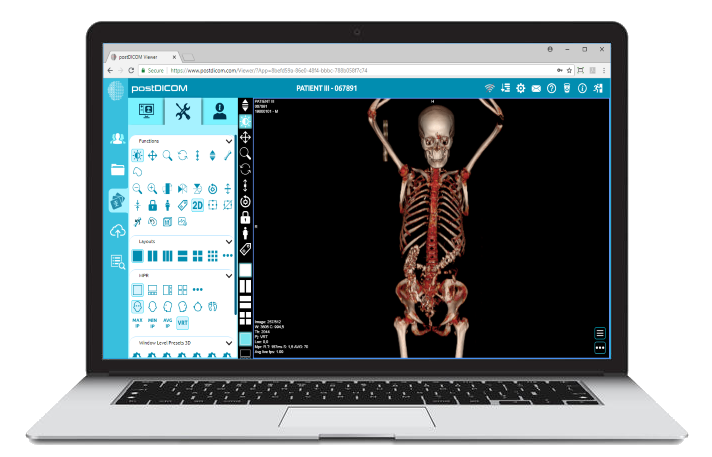
Cloud PACS and Online DICOM ViewerUpload DICOM images and clinical documents to PostDICOM servers. Store, view, collaborate, and share your medical imaging files. |